
Blogs
Custom Backpacks: Latest Design Trends & Tips
17
Nov
Nov
Custom backpacks offer more than a place to display a logo: they bring together personal style, everyday organization, and brand identity. Design directions worth exploring include coordinated color panels, textured embroidery, all-over artwork, practical storage, and smaller production runs. Current customization programs illustrate these possibilities, giving businesses, teams, and individuals several ways to create a bag around its intended user. (timbuk2.com)
The challenge is choosing which ideas belong together. Use the trends below as a design toolkit, not a checklist of features every backpack needs.
What trends are shaping custom backpack design?
The most useful directions combine visual personalization with a clear purpose: configurable colors for individual expression, embroidery for textured branding, printed patterns for artwork-led designs, and work-ready features for everyday carry. Suppliers such as Timbuk2 offer configurable backpack colors, while print-on-demand providers offer embroidery, all-over printing, and single-unit ordering. These are available design approaches, rather than a measured ranking of market popularity. (timbuk2.com)
Start by describing the recipient’s day. Someone carrying a laptop between meetings needs a different starting point from someone buying illustrated merchandise. Before choosing colors or decoration, write a short brief covering:
- Primary use: Commuting, classes, travel, events, or casual outings.
- Typical contents: The actual device, bottle, clothing, and accessories the bag should accommodate.
- Visual personality: Understated, athletic, playful, artistic, or company-focused.
- Ordering approach: A one-off gift, a sample run, or a coordinated group order.
Use those answers to filter ideas. A striking finish should support the brief, not distract from it.
1. Color Blocking That Makes the Whole Bag Feel Personal
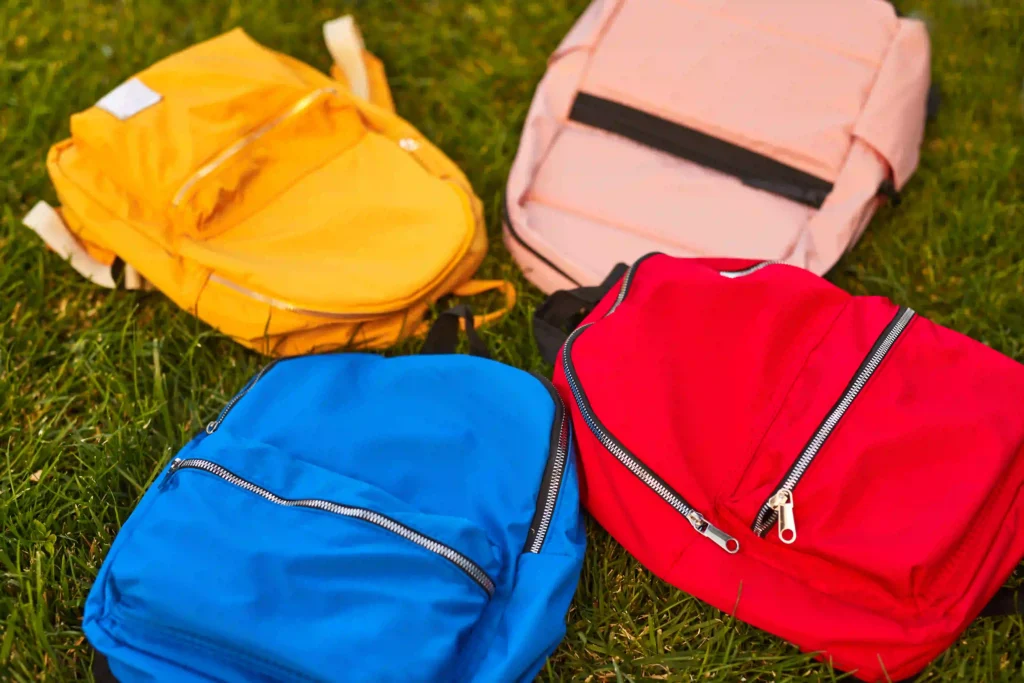
Customization can extend beyond adding artwork to a standard black bag. Timbuk2’s custom program, for example, lets buyers coordinate or contrast colors, and its custom Prospect offers multiple fabric and color choices. That opens the door to treating the backpack itself as the design rather than simply a background for decoration. (timbuk2.com)
For your own concept, try a restrained formula: one main color, one supporting color, and one accent. A navy body with gray panels and a bright zipper detail could suggest a different personality from an entirely neutral version. Keep the proposed palette small enough that each choice has a role.
For branded backpacks, consider using a secondary brand color on a panel rather than enlarging the logo. Ask for front, side, and rear mockups before approving the combination. Review the design as a complete object, including straps and trim.
2. When is an embroidered backpack the right choice?
An embroidered backpack is worth considering when the design centers on a bold logo, readable lettering, or a simple emblem and you want a stitched texture. Embroidery recreates artwork in thread, so fine lines, tiny text, and intricate details require particular care. Standard embroidery also calls for solid colors rather than gradients, according to Printful’s preparation guidance. (help.printful.com)
Treat embroidery artwork as its own design task. Instead of shrinking a detailed company lockup, consider submitting a simplified symbol for approval. Keep the full version available for packaging or accompanying materials if it cannot be reproduced clearly at the proposed size.
Ask the decorator to review the artwork against the exact backpack and placement. Request a stitched sample when possible, then inspect letter spacing, edges, and color contrast. Printful notes that digital embroidery previews can differ from the finished result, which makes this review especially useful. (help.printful.com)
3. Deliberate Backpack Logo Placement
Make placement a design decision before finalizing artwork size. Depending on the product, customization options can include front pockets, flaps, straps, or all-over decoration; the eligible areas and methods vary by model. Start with the supplier’s template rather than assuming every visible surface is available. (printify.com)
For a work-focused concept, try a modest backpack logo surrounded by clear space. For an event or team concept, explore a more prominent front-facing mark. Neither approach needs to win universally: compare them against the recipient and occasion described in your brief.
During approval, ask to see the decoration at its actual dimensions, not only enlarged on a screen. Check whether you prefer the mark centered on the whole bag or aligned within one pocket. Also decide whether existing manufacturer branding fits comfortably beside your own.
4. All-Over Artwork for a More Expressive Look
All-over printing provides an alternative to a single logo placement. Printful offers backpacks whose fabric is printed with the custom design before being cut and sewn, allowing the artwork to become part of the bag’s overall appearance. This approach creates room for patterns, illustrations, and full-color concepts. (printful.com)
Consider a repeating illustration for an artist’s merchandise collection, an abstract motif based on team colors, or a geometric pattern for a school organization. Give the design a clear focal strategy: either let the pattern lead or reserve a quieter area for a main graphic. Avoid asking every panel to compete for attention.
Use the product template to review the artwork panel by panel. Ask the supplier how seams and pockets affect the finished composition, especially if a particular element must appear intact. Order a sample before committing to a design that depends on precise alignment.
5. Everyday Function as Part of the Design
A customizable backpack does not have to begin with decoration. Existing custom collections include options with laptop padding, multiple pockets, and expandable storage, while corporate ranges include bags intended for commuting and business travel. Function gives you another way to distinguish the finished product. (timbuk2.com)
Build a feature shortlist around the recipient rather than choosing the model with the longest description:
- For commuters: Prioritize device fit, accessible essentials, and a manageable packed shape.
- For students: Check room for the expected books, technology, and daily supplies.
- For travelers: Review document access, packing layout, and any luggage attachment requirements.
- For event recipients: Consider what someone would carry after the event, not just during it.
Test shortlisted samples with representative contents. Ask a few intended users to pack, carry, and unpack them, then record what feels awkward. Make the final choice before adapting the artwork to its decoration area.
6. Material Choices With Specific Supporting Details
Recycled-material options are another direction to explore. Timbuk2’s corporate collection identifies several recycled-material bags, while Osprey specifies recycled fabrics and material certifications for its Daylite Plus. These examples show why product-level information is more useful than a broad description such as “green backpack.” (timbuk2.com)
When sourcing custom backpacks with logo decoration, request the material details for the exact model you intend to order. Ask which components the recycled-content description covers and what documentation the supplier can provide. Keep your own product copy equally specific, without extending a fabric attribute into an unsupported claim about the entire bag.
Also ask for care guidance and inspect the physical sample. Your brief should address how the bag will be used and maintained, alongside what its materials are called.
7. Small-Run Personalization and Sample-First Ordering
Single-unit ordering makes it possible to explore a design without immediately committing to a large batch. Printful and Printify both advertise custom backpack options without order minimums. Availability still needs checking against the particular product and decoration method you choose. (printful.com)
If you are searching for “custom backpacks no minimum,” use that flexibility to test rather than rush. Start with one sample, review it with intended recipients, and revise the design before expanding the order. For a group, consider whether one shared layout with a small choice of colors would meet individual preferences without creating too many versions.
Bring the Design Together Before Ordering
The strongest concept is the one you can explain clearly and approve confidently. Before production, work through a final checklist:
- Confirm the use case. Make sure the selected bag answers the original brief.
- Lock the artwork. Approve the correct logo version, colors, placement, and dimensions.
- Review a sample. Inspect both the decoration and the packed bag.
- Confirm order details. Ask about quantities, personalization, proofs, and delivery expectations.
- Save the specification. Keep approved files and product details together for future discussions.
Choose a few complementary ideas rather than every available option. A considered palette, suitable decoration, and useful bag layout give your custom backpack a clear reason to exist—and a design you can stand behind.